The Hidden Layer in Every Customer Call
Contact Centers & CX
Blog

Chloe Duckworth
Context Missing From Call Data
Organizations measure customer conversations relentlessly. Duration, resolution, compliance, sentiment, and satisfaction scores all help quantify performance. These metrics describe calls as transactions, but rarely as experiences.
Emotion is present in every conversation. It shapes how customers interpret responses and how agents carry cognitive and emotional load throughout the day. When emotion is not measured, it becomes an invisible variable influencing outcomes without accountability or insight.
This gap forces leaders to infer experience indirectly. Coaching decisions are made from transcripts, scores, and summaries rather than from what actually unfolded in the moment. Patterns of frustration, disengagement, or emotional fatigue often surface only after performance declines.
Valence AI approaches this problem by treating emotion as a first-class signal, not an afterthought.
What Emotion Looks Like When You Can Measure It
When vocal emotion is measured, conversations reveal a second layer of information. Calm language may coexist with rising frustration. Polite phrasing may mask disengagement. Resolution may occur after trust has already eroded.
Valence AI analyzes vocal characteristics to surface this layer clearly. Instead of abstract labels or post-call assumptions, teams can see how emotion evolves over time, where tension accumulates, and which moments carry the most emotional weight.
This reframes analysis from subjective interpretation to observable dynamics.
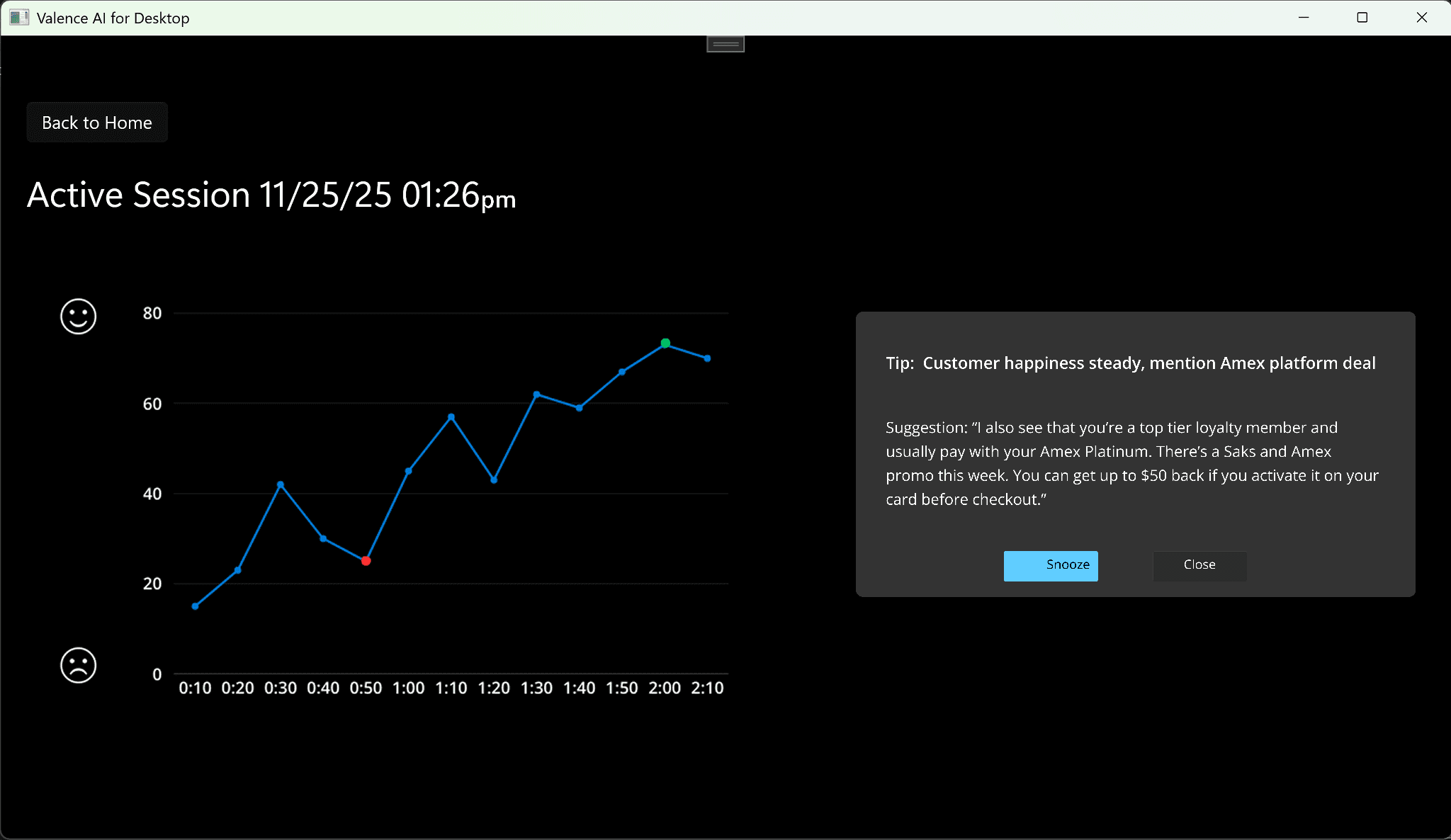
Image: Datamark agent screen showing sentiment at scale across live conversations.
Sentiment analysis visualized across an active customer interaction, revealing emotional shifts that are not visible in transcripts alone.
Why Timing Matters More Than Tone
Emotion is not static. It rises, falls, and shifts direction throughout a conversation. A single emotional inflection point can outweigh everything said before or after it.
Traditional tools flatten this timeline. They summarize calls as outcomes. Valence AI preserves emotional sequence, allowing organizations to understand not just how a call ended, but how it unfolded.
This temporal visibility matters because coaching effectiveness depends on timing. Acknowledgment offered too late feels procedural. Recognition delivered at the right moment feels human.
From Awareness to Better Decisions
When emotional shifts are visible, intervention becomes possible without escalation. Support does not require scripting or automation. It comes from awareness.
Rather than replacing agents or supervisors, emotional intelligence augments human judgment by surfacing context that would otherwise be imperceptible. Decisions improve because they are informed by how the conversation is actually being experienced.
AI’s role shifts from evaluator to assistive intelligence.
Operational Effects Beyond the Call
When emotion is consistently visible, its impact extends beyond individual interactions.
Supervisors gain clarity into coaching priorities based on emotional patterns rather than isolated incidents. Agents receive feedback grounded in lived experience instead of generalized advice. Training evolves to include emotional timing and pacing as core skills.
Most importantly, emotional load stops being invisible. Sustained strain can be identified early, allowing organizations to support agents before burnout manifests as attrition or performance decline.
Scenario Illustration: Rescheduling Under Stress
A customer contacts a dental office to reschedule an appointment after already taking time off work. The conversation remains civil and concludes with a new appointment booked.
On the surface, the call appears successful.
Valence AI detects a spike in frustration at the moment limited availability is explained. The agent responds politely but accelerates delivery, unintentionally increasing tension. The issue is resolved, but the emotional experience degrades.
With this insight, supervisors coach agents to slow pacing and explicitly acknowledge inconvenience at that moment. No scripts are changed. No policies are altered.
The improvement comes from emotional alignment, not procedural change.
Reframing Supervision
Supervision has traditionally focused on control, consistency, and correction. Emotional visibility allows it to evolve into guidance, support, and development.
AI does not replace human judgment. It strengthens it by revealing information humans were never able to perceive at scale.
When supervisors understand emotional dynamics, they stop reacting to outcomes and start shaping experiences.
Closing Perspective
Emotion has always influenced customer conversations.
What has changed is the ability to see it clearly.
Valence AI enables organizations to understand calls as lived experiences, not just logged events, creating a foundation for more human, resilient, and effective operations.

" height="16.25px" id="ZmodORJZn" transform="translate(2.5 1.25)" width="16.25px"/></g></svg>)